

Story Analysis
How do you see story?

What makes a good story?
I read a lot of books. Somewhere around 2015 I started writing. I’ll eventually get around to why, but for now, all you need to know is that when I started writing, I couldn’t get the vision in my head reflected on the page. So as I wrote my story, I began to read about writing.
Now, I’ve read and re-read more than 50 books on the craft of storytelling. I’ve consumed countless hours of YouTube videos on writing for the page and the screen including Brandon Sanderson’s BYU creative writing lectures. As I consumed all this content, I continued to write. I would learn a framework and implement it. Soon I was creating my own frameworks and working them into my stories. I began to see novels and film through the lenses of theme and subtext. So I started a podcast to talk about what I had learned.
I don’t recall where I first heard the “ugly pancake” concept, but it’s brilliant. The idea is, the first draft of anything is like the first pancake. The shape is a little fucked up. It’s either too light or slightly charred. My first story was like this. But I hadn’t intended to write multiple stories. I have a job. I just had a story in me that needed to get out. But when this 155,000 word monstrosity landed on the page, it was kinda janky. Oh, it tasted fine, but something about it felt uncanny valley – like the bug wearing Edgar’s skin in the first Men in Black movie. Passable at a distance, but very wrong when examined up close.
The first several podcasts were ugly pancakes too. It took probably 40 episodes of me ranting and bitching before I started really analyzing stories. I started to apply the frameworks I had learned to answer the question I posed in the very first episode: what makes a good story?
The ABT
A good story is one that effectively uses plot, character, and setting to articulate the theme. Using this definition, I found a few helpful frameworks to evaluate and score a story. The first of which is the ABT.
There’s a video from years ago where Matt Stone and Trey Parker, the creators of South Park, visit an NYU creative writing class and talk about this framework. It’s a simple way to ensure you have a story and not just a situation or sequence of events.
[situation] AND [goal] BUT [conflict] THEREFORE [resolution/setback]
This can be used to encapsulate the core plot of an entire story, a scene, or a simple exchange of dialogue. I use it to frame the entire story, then in conjunction with the second framework I use in story analysis: the SG4.
The SG4
This framework comes from the Story Grid by Shawn Coyne. He was a professional editor who came up with a way to evaluate stories on a spreadsheet so I was immediately a fan. His method focuses on what he calls the 5 Commandments of Story which are essentially the 5 plot points each story must go through: the inciting incident, complication, crisis, climax, and resolution. There are many different ways to plot a story, and after overlaying them atop one another, I find this one the most useful but with a twist. Instead of the standard 3- or 5-acts, I prefer the 4-act structure, hence the SG4 (i.e. Story Grid 4).
Incident: starts off the story
Complication: escalates the dramatic tension
Crisis: all hell breaks loose book ended with a false victory or defeat
Climax & Resolution: the final confrontation occurs and we see the results of the conflict
Each of these functions as an act in the story in which I can apply an ABT. It also maps easily onto the Hero’s Journey, Save the Cat, and the Nutshell. The latter of which is my fourth analytical framework, but before I can explain that one, we need the Disney Song.
The Disney Song
The Disney Song, I credit to Abbie Emmons. She made a video about how Disney movies hack your brain, where she describes how the opening song in a Disney movie tends to prime you for the protagonist’s transformation arc. What Abbie calls the fear, flaw and false belief (I love a good alliteration), I modified into: proximate cause, fear, lie, flaw, distortion, desire, truth, and strength. This is the most important part of the story. If the character transformation is poorly constructed, it doesn’t matter how good the plot or setting, generally speaking, the story won’t work. Why? BIDAR. Our beliefs create our interpretation of the world. Our interpretation of the world drives what decisions we make. The decisions we make dictate the actions we take. The actions we take generate our results. This is the essence of story. The character transformation connects the audience to the character by showing how their beliefs influence the decisions they make at each stage of the plot. If the character takes an action because the plot needed it to happen, we literally call it “out of character” because from what we know of the character’s beliefs and interpretations, they wouldn’t act this way.
The proximate cause (aka wound, trauma, shard of glass, etc.) is the event that occurred at some point in the past to produce a negative behavioral pattern in the protagonist.
The fear arises from the pain of the proximate cause as the feeling or scenario the protagonist would do anything to avoid.
The lie is the limiting belief that springs from the fear as a coping or defense mechanism (see where I’m going with this…?).
The flaw is the recurring dysfunctional behavior that arises from the lie (the avoidant belief).
The distortion comes from Cognitive Behavioral Therapy, it’s essentially a lens a person puts on to filter out negative experience, but by distorting reality, you aren’t actually preventing the negative experiences, you’re just failing to see them clearly. This is different from the belief because a distortion is more of a veil that can be added or removed regardless of the existence of the belief.
The desire is what the character wants, but the flawed behavior will never produce it. For example: I want a girlfriend, but I never talk to girls.
The truth is empowering belief that creates post-traumatic growth. Whereas the lie was a belief that perpetuates the avoidance of fear, the truth is a belief that necessitates confrontation of fear.
The strength is the proactive behavior driven by the truth, the empowering belief, that overcomes the fear. It doesn’t always result in achieving the want, but this new behavior improves the outcomes for the character.
The Nutshell
While there are a few other frameworks I’ve added into the mix, I’ll put this all into a nutshell for you. The Nutshell framework comes from Jill Chamberlain and links both positive and negative transformation arcs with the core events of the plot. She focuses on the 0%, 25%, 75%, 80% and 90% marks of a story. I include 50% and focus mostly on the beginning and ends of the 4-acts.
Setup want (0%): the thing the protagonist wants from the outset; this typically isn’t the goal for entire story, but is related to or a component of the overall story goal
The curtain (25%): the protagonist gets the setup want, but has a setback. I call this stage the curtain because the protagonist gets a glimpse beyond the veil of the cognitive distortion.
The moment of truth (50%): this is where the protagonist takes a good look at themselves in the mirror and sees the truth about their avoidant behavior and false belief.
The crisis (75%): at this point, the protagonist is confronted with their fear and the flawed behavior causes them a great loss. Having experienced the moment of truth, they know the flawed behavior is what caused the loss, but they’re still afraid to give up the lie.
The chasm (80%): Chamberlain calls this the climactic choice, but I call it the chasm because the character must take a leap of faith to let go of the lie and choose not to do the flawed behavior, but the strong behavior instead. Regardless of the choice, there will be pain, so you might as well do the strong behavior…
The Ending
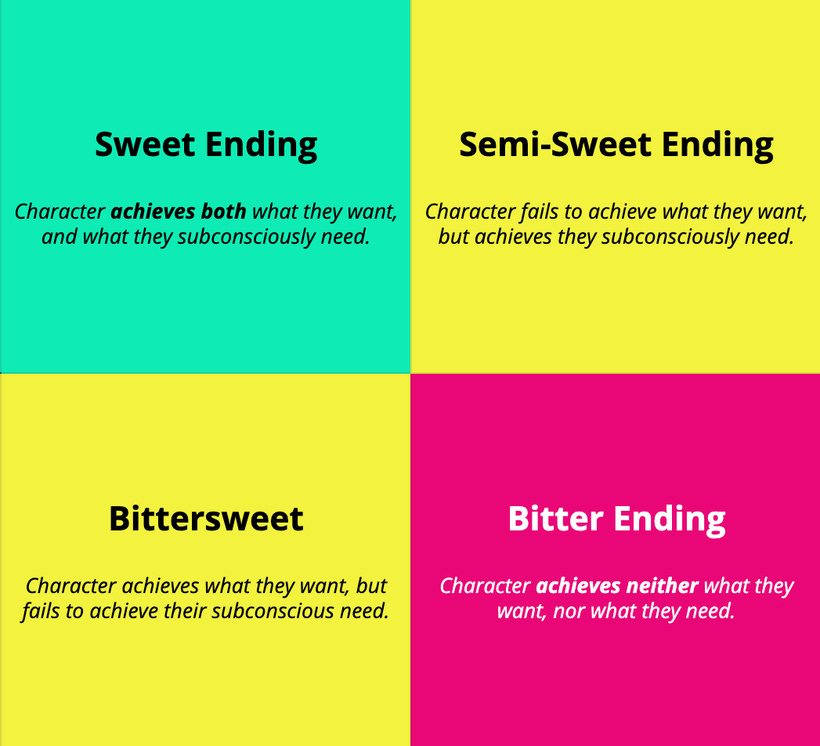
I also do an analysis of the setting, but that framework is still a work in progress, so I’ll keep you posted. As a bonus, Studiobinder identifies four types of ending as sweet, bitter, bittersweet, and semi-sweet. These are based on whether the protagonist gets the want, the need, both, or neither.
Now that you know how I evaluate a story, I’ll post a few podcast episodes so you can see the process. Beware, you may never see stories the same way again.